
Introduction
Bronchiolitis obliterans syndrome (BOS) is a pulmonary manifestation of chronic graft-versus-host disease (GVHD) characterized by progressive airflow obstruction following hematopoietic stem cell transplantation (HSCT). Although uncommon, BOS develops in approximately 5–14% of HSCT recipients, with variability largely attributable to differing diagnostic criteria and lack of consensus among experts.1,2 BOS is a life-threatening and life-altering condition associated with substantial morbidity, reduced quality of life, and high mortality.
The pathophysiology of BOS remains incompletely understood but is thought to parallel GVHD-associated injury in other organs. Pulmonary GVHD is characterized by chronic alloimmune-mediated injury and inflammation leading to fibroblast activation, irreversible small airway fibrosis, and progressive airflow obstruction often presenting in irreversible disease when symptoms start.3
First-line therapy for BOS typically includes inhaled fluticasone, azithromycin, and montelukast (FAM) in combination with systemic corticosteroids, with or without additional immunosuppressive agents such as tacrolimus or cyclosporine.4,5 Available data suggest greater benefit when treatment is initiated within six months of diagnosis and in mild disease. Ruxolitinib, a Janus kinase inhibitor, has demonstrated efficacy in steroid-refractory GVHD, yet pulmonary involvement, especially in moderate and severe disease, remains associated with poor treatment response.1–3 Despite aggressive multi-line therapy, up to one-third of patients continue to experience progressive lung function decline. This case describes severe steroid-refractory and ruxolitinib-refractory BOS secondary to chronic GVHD that demonstrated clinical and physiologic stabilization following addition of adjunctive sirolimus with ruxolitinib. To our knowledge, adjunctive sirolimus with ruxolitinib as a third-line agent has not previously been reported for progressive BOS.
Case Report
A 24-year-old male with B-cell acute lymphoblastic leukemia (B-ALL) underwent chemotherapy followed by chimeric antigen receptor (CAR) T-cell therapy with tisagenlecleucel (Kymriah). He relapsed and achieved remission before undergoing HSCT. His post-transplant course was complicated by GVHD involving the skin, treated with tacrolimus and mycophenolate mofetil, followed by intermittent systemic budesonide for upper gastrointestinal manifestations.
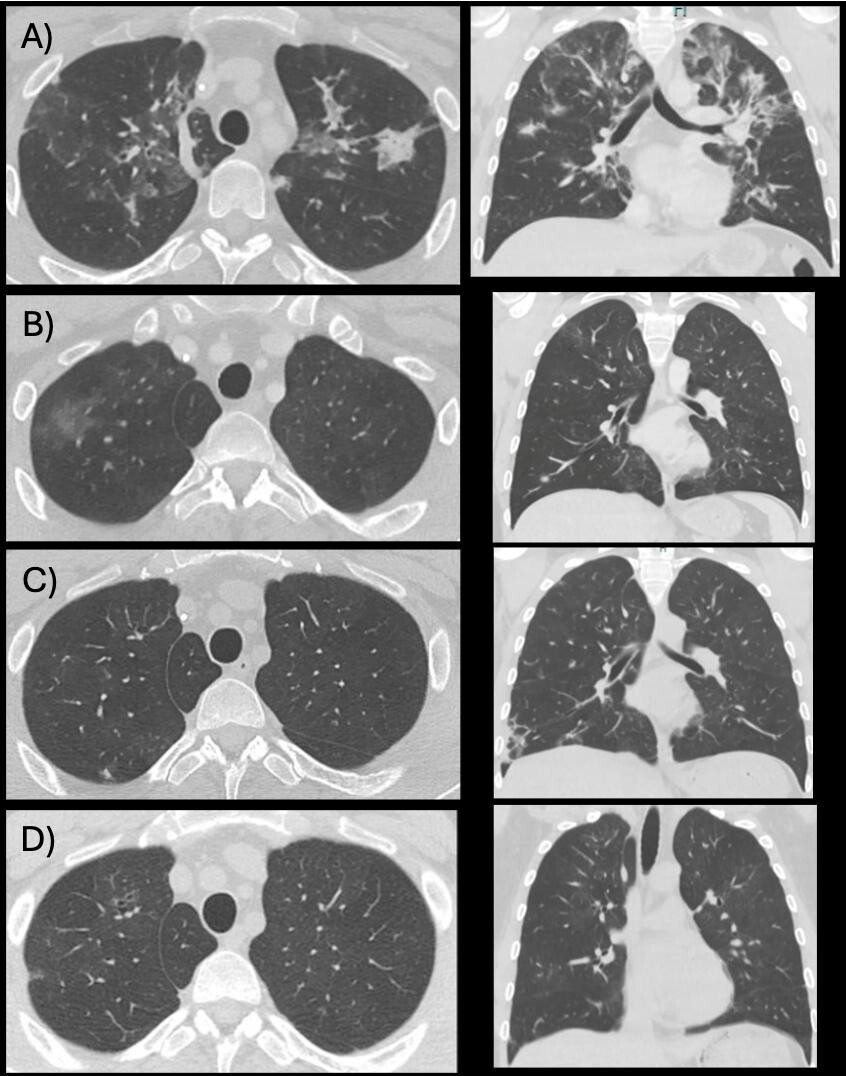
Due to recurrent GVHD flares, ruxolitinib (10 mg twice daily) was initiated six months after diagnosis. Four months later, he developed pulmonary involvement presenting with cough, shortness of breath, hypoxia, and fevers requiring hospitalization. Computed Tomography (CT) chest imaging showed multinodular airspace opacities concerning for pneumonia (Figure 1A). He was treated with broad-spectrum antibiotics and high-dose methylprednisolone. Initial spirometry demonstrated severe obstructive lung disease (Table 1). He was diagnosed with pulmonary GVHD and was started on FAM therapy, continued ruxolitinib, and discharged with a long corticosteroid taper. Corticosteroid therapy was not well tolerated due to side effects.
_and_coronal_(right)_images_of_ct_chest_at_various_time_points.jpeg)
He was admitted the following year for upper respiratory symptoms and diarrhea with a viral respiratory panel positive for adenovirus and respiratory syncytial virus. CT chest showed scattered ground-glass opacities in the right upper lobe and scattered nodular densities in the mid and lower lung fields bilaterally (Figure 1B). Infectious disease was consulted to assist with treatment of disseminated adenovirus infection, with recommendations to administer Cidofovir and probenecid. Intravenous immunoglobulin (IVIG) was given once due to low CD3, CD4, and CD8 counts to further assist in viremia clearance, with clinical improvement. After discharge, he had progressive dyspnea and decline in pulmonary function testing (PFT) (Table 1).
He was referred to the pulmonology clinic for evaluation. Medications included Montelukast, budesonide-formoterol, fluticasone, azithromycin, hydrocortisone, ruxolitinib, sulfamethoxazole-trimethoprim, and amoxicillin. Vital signs were unremarkable. Physical exam was notable for a dry and pink rash on his arms. His lung exam was normal. Given refractory disease, alternative treatment options and lung transplant evaluation were recommended; however, the latter option was declined.
After multidisciplinary discussion with oncology, tacrolimus was started and then switched to sirolimus within 4 days. FAM therapy and ruxolitinib were continued as well. Since addition of Sirolimus, a repeat PFT showed stable obstructive disease (Table 1) and a high-resolution CT chest with overall improvement compared to prior imaging showing resolution of prior multifocal ground-glass and nodular opacities with an increase in upper lobe bronchiectasis (Figure 1D).
Discussion
BOS in patients with chronic GVHD remains a severe complication of HSCT with limited data on effective treatment for advanced disease. This case highlights treatment with adjunctive sirolimus with ruxolitinib may be an effective third line therapy in severe steroid-refractory and ruxolitinib-refractory BOS. There are no cases to our knowledge that describe using sirolimus in addition to ruxolitinib to treat progressive BOS.
Early detection and treatment initiation are crucial to prevent progression of severe BOS. BOS primarily affects small airways and often presents clinically after irreversible fibrosis has
developed. Studies suggest that FEV₁ declines between HSCT and BOS diagnosis, prompting guidelines to recommend PFT screening every 3 months during the first-year post-transplant.3,6 However, implementation remains inconsistent.3 Poor prognostic factors for BOS include severe airflow obstruction at diagnosis, delayed diagnosis, delayed therapy initiation, and continued decline in FEV1 despite therapy.6–8 Our patient had several of these factors, making stabilization of his disease with adjunctive sirolimus notable.
BOS frequently progresses, which requires escalation of therapy. A phase II, open-label, multicenter trial evaluated the early effect of ruxolitinib in BOS by Massachusetts General Hospital.6 They found that early ruxolitinib improved lung function in 27.8% of patients with newly diagnosed BOD, while 92% of patients with established BOD achieved stabilization of lung function over three months, suggesting the greatest benefit may be seen with early treatment. Patients with mild-to-moderate BOS were most likely to meet their endpoints, demonstrating a clinically significant positive response to ruxolitinib.6 Despite these promising data, patients with severe or longstanding obstructive lung disease can be refractory to ruxolitinib, as in our case.
Given our patient’s continued decline, sirolimus was added to ruxolitinib as a third-line treatment for BOS. Sirolimus inhibits the mammalian target of rapamycin (mTOR) pathway, which reduces cell growth, proliferation, and angiogenesis. It has been used in acute and chronic GVHD as a treatment or prophylactic medication, often for steroid sparing. Combining medications that mitigate the immune reaction and proliferation of cells in the small airways is proposed to reduce progression and potentially reverse fibrosis caused by BOS. By adding sirolimus to ruxolitinib as a third-line treatment, our patient had symptomatic improvement, stabilization of spirometry, and radiologic improvement, making this treatment combination a promising option in steroid-refractory and ruxolitinib-refractory BOS. Although sirolimus is well tolerated, clinicians should monitor adverse effects including cytopenias, hyperlipidemia, impaired wound healing, nephrotoxicity, and infections. The contribution of adenovirus to the patient’s disease is uncertain. Viral infections can cause airway epithelial injury and accelerate alloimmune-mediated inflammation, potentially contributing to BOS. However, progressive airflow obstruction had already been well documented before the disseminated adenovirus infection.
This case underscores the importance of early routine surveillance of BOS post-HSCT to enable timely intervention and prevent progression to severe BOS, which is often refractory to treatment. It is important to consider sirolimus and ruxolitinib as a third-line option for steroid-refractory and ruxolitinib-refractory BOS. Interpretation of this case is limited by a single patient report, concurrent therapies, and relatively short follow-up, precluding conclusions regarding causality and long-term efficacy.