
Introduction
Obstructive sleep apnea (OSA) is one of the most common sleep disorders worldwide. A literature-based analysis by Benjafield et al. estimated that approximately 936 million adults aged 30 to 69 years have mild-to-severe OSA globally, with moderate-to-severe disease afflicting nearly 425 million individuals—figures that underscore the enormous public health burden of this condition.1 OSA is characterized by repetitive pharyngeal collapse during sleep, resulting in intermittent hypoxemia, hypercapnia, and recurrent arousals, and is independently associated with cardiovascular disease, metabolic dysfunction, neurocognitive impairment, daytime sleepiness, and reduced quality of life.2
Positive airway pressure therapy, delivered as continuous positive airway pressure (CPAP), remains the gold standard treatment. While CPAP is highly efficacious when used consistently, real-world adherence is limited by a range of patient-reported barriers including mask discomfort, claustrophobia, pressure intolerance, and noise.3 A systematic review by Rotenberg et al. that tracked CPAP non-adherence across twenty years of published data found an overall non-adherence rate of 34.1% and, critically, no meaningful improvement in this figure despite advances in device and mask interface design and behavioral coaching—leading the authors to question the appropriateness of CPAP as the unchallenged gold standard for all patients.4 Long-term adherence rates as low as 40% have been reported, and a substantial proportion of patients ultimately abandon therapy.5 Alternative therapies including oral appliances, upper airway surgery, positional therapy, and weight management address selected patient populations but are individually constrained by variable efficacy or invasiveness. Mandibular advancement devices (MADs), for example, provide smaller AHI reductions than CPAP but achieve comparable quality-of-life outcomes due to superior real-world adherence, particularly in mild-to-moderate disease.6
The past several years have witnessed an unprecedented expansion in therapeutic options for OSA, spanning device-based innovations, pharmacology, and neuromodulation. This review summarizes the current evidence for several new therapeutic developments: a novel CPAP algorithm designed to improve comfort and adherence, two pharmacotherapeutic agents, a transoral daytime neuromuscular electrical stimulator, and additional options for hypoglossal nerve stimulation. This review is confined to the management of OSA in adults. Pediatric OSA differs substantially both in pathophysiology, where adenotonsillar hypertrophy rather than obesity-related pharyngeal narrowing predominates, and in its treatment algorithm, where adenotonsillectomy rather than positive airway pressure is first-line therapy. None of the modalities discussed here has been evaluated in children, and pediatric management is therefore outside the scope of this review.
Methods
This narrative review summarizes recent developments in the treatment of OSA across positive airway pressure technologies, pharmacotherapy, neuromuscular electrical stimulation, and hypoglossal nerve stimulation therapies. PubMed/MEDLINE and Google Scholar were searched for clinically relevant studies in adult populations published through March 2026, with primary emphasis placed on studies published from 2019 onward, while earlier landmark studies relevant to OSA epidemiology, CPAP adherence, and neurostimulation were also included. Studies conducted exclusively in pediatric populations were excluded.
Search terms included combinations of “obstructive sleep apnea,” “CPAP,” “positive airway pressure,” “Kairos PAP,” “tirzepatide,” “GLP-1 receptor agonist,” “AD109,” “atomoxetine,” “aroxybutynin,” “eXciteOSA,” “neuromuscular electrical stimulation,” “hypoglossal nerve stimulation,” “Genio,” “aura6000,” “OSPREY,” “THN3,” “hypoxic burden,” and “OSA endotyping.” Supplementary searches conducted after initial preparation of the review additionally used the terms “AutoSet for Her,” “female-specific CPAP algorithm,” “tongue fat,” “parapharyngeal fat pad,” “sympathetic activation,” “sulthiame,” “acetazolamide,” “carbonic anhydrase inhibitor,” and “solriamfetol.”
The initial search identified 187 studies, of which 30 were included; supplementary searches identified 8 further studies that were also included, yielding 38 studies in total. Studies were selected based on clinical relevance, methodological quality, and contribution to evolving concepts in OSA treatment. Given the narrative nature of this review, formal systematic review methodology, risk-of-bias assessment, and meta-analysis were not performed.
Advances in Positive Airway Pressure Technology
Despite decades of device refinement, one of the fundamental discomforts of CPAP, a constant elevated pressure throughout the entire respiratory cycle has proven difficult to address. Prior attempts to relieve expiratory pressure burden through use of delivering higher inspiratory pressures than expiratory pressures (bilevel PAP) or expiratory pressure relief algorithms have not demonstrated meaningful improvements in adherence.3 These strategies consistently reduce expiratory pressure below inspiratory pressure, which may paradoxically worsen upper airway collapsibility by reducing tracheal traction and pharyngeal cross-sectional area.3 A parallel effort targeted a specific patient phenotype rather than the pressure profile itself. Recognizing that women with OSA exhibit proportionally greater inspiratory flow limitation, more respiratory effort-related arousals, and a higher proportion of events occurring in REM sleep than men, a female-specific autotitrating algorithm (AutoSet for Her) was developed to increase sensitivity to inspiratory flow limitation while moderating the rate and magnitude of pressure change, with the aim of reducing arousal burden and improving comfort. In a randomized crossover noninferiority trial in 20 women established on long-term CPAP, the female-specific algorithm was noninferior to the standard algorithm with respect to AHI and oxygen desaturation index and significantly reduced flow limitation at modestly lower delivered pressures; however, it did not translate into the improvements in comfort or treatment acceptance that had motivated its development, and the single-night design precluded any assessment of adherence.7 Whether modifications targeted the pressure differential between inspiration and expiration or the responsiveness of the titration algorithm itself, these efforts share a common result: refinements to how conventional positive pressure is delivered have repeatedly failed to resolve the underlying tolerability problem. This provides the rationale for reconsidering the shape of the pressure waveform itself.
Recently, the opposite approach was employed by reducing inspiratory positive airway pressure (IPAP) 1.5-2 cm H2O by addition of a non-compensated resistor to the CPAP circuit resulting in some improvement in CPAP usage.8 This concept was extended by developing an automated algorithm that drops IPAP by up to 5 cmH2O at the onset of inspiration and at peak inspiratory flow, maintaining this reduced pressure through much of expiration before returning to the therapeutic baseline level toward end expiration, where airway patency is most critical.3 This algorithm is commercially available on a proprietary CPAP platform designated as Kairos PAP or KPAP by its developers.
White et al. reported two prospective randomized trials of KPAP.3 In the Efficacy trial (N=48), KPAP was compared with CPAP in a split-night polysomnographic design among patients with established OSA on chronic CPAP therapy. KPAP did not compromise respiratory event control; in fact, the apnea-hypopnea index (AHI) was modest but significantly lower with KPAP than CPAP (mean difference −0.5 events/h, P=0.007). Importantly, unintentional mask leak was reduced by approximately 40% with KPAP compared with CPAP (2.0 L/min decrease, P<0.001), a clinically meaningful finding given the role of leak in reducing therapy effectiveness, patient comfort, and adherence.9
In the Comfort trial (N=150 PAP-naïve participants), subjective preference was assessed during brief wakefulness exposures at baseline pressures of 9 and 13 cmH2O. Sixty-nine percent of participants preferred KPAP over CPAP at 9 cmH2O, and 84% preferred KPAP at 13 cmH2O (both P<0.001). Overall, 93% to 95% of participants chose some level of KPAP pressure drop over standard CPAP.3
These findings challenge the long-held assumption that maintaining a constant IPAP is necessary for upper airway patency during sleep and suggest that KPAP may represent a potentially important advancement in the tolerability of CPAP therapy. However, larger and longer duration studies will be required to determine whether KPAP is preferable to standard CPAP.
Pharmacotherapy
GLP-1/GIP Receptor Agonists: Tirzepatide
Excess adiposity is recognized as a major modifiable risk factor for OSA, with an estimated 39% of individuals with moderate and 47% with severe OSA meeting criteria for obesity.10 Weight loss through lifestyle intervention, bariatric surgery, or pharmacotherapy has demonstrated dose-dependent reductions in OSA severity. Upper airway imaging has clarified the anatomical basis of this relationship. In a study of 67 adults with obesity and OSA who underwent magnetic resonance imaging before and after intensive lifestyle modification or bariatric surgery, weight loss significantly reduced tongue fat, parapharyngeal fat pad volume, lateral pharyngeal wall volume, and pterygoid volume. Reductions in tongue fat correlated strongly with reductions in AHI (rho = 0.62, P < 0.0001), an association that persisted after controlling for the magnitude of weight loss, and mediation analysis identified tongue fat as the principal mediator of the improvement in AHI attributable to weight loss.11 Because the tongue and the parapharyngeal fat pads are direct anatomical determinants of pharyngeal cross-sectional area and collapsibility in patients with obesity, these findings indicate that weight reduction acts on OSA through a defined structural mechanism rather than through a nonspecific association with body habitus, and they provide the rationale for expecting pharmacologically induced weight loss to improve upper airway patency.
Starting in 2005, agonists of glucagon-like-peptide-1 (GLP-1) were introduced as treatment for type 2 diabetes. Subsequently, they were noted to induce weight loss and became alternatives to bariatric surgery. This led to several clinical trials of the GLP-1 agent, liraglutide, in the treatment of obese individuals with OSA. These studies demonstrated a reduction in weight and the AHI,12 thus providing a proof of concept for use of GLP-1 agents in OSA treatment. Tirzepatide, is not only a glucagon-like peptide-1 (GLP-1) receptor agonist, but also a long-acting glucose-dependent insulinotropic polypeptide (GIP) that has been shown to be effective in the treatment of obesity.13 Recently, it was studied as a therapy for obese persons with OSA in the SURMOUNT-OSA trials.2
The SURMOUNT-OSA program comprised two Phase 3, double-blind, randomized, placebo-controlled trials evaluating weekly subcutaneous tirzepatide (maximum tolerated dose of 10 or 15 mg) in adults with moderate-to-severe OSA (AHI ≥15 events/h) and obesity (BMI ≥30 kg/m2).2 Trial 1 enrolled 234 participants not currently using PAP therapy, while Trial 2 enrolled 235 participants who were established on PAP and instructed to suspend it for 7 days prior to sleep assessments. Both trials included lifestyle counseling for all participants. The primary endpoint was change in AHI from baseline at 52 weeks.
In Trial 1, tirzepatide produced a mean AHI reduction of 25.3 events/h compared with 5.3 events/h with placebo (estimated treatment difference −20.0 events/h, P<0.001). In Trial 2, tirzepatide reduced AHI by 29.3 events/h versus 5.5 events/h with placebo (treatment difference −23.8 events/h, P<0.001).2 These reductions are clinically substantial; tirzepatide recipients in Trial 2 experienced a 58.7% percent reduction in AHI from baseline. Furthermore, 61.2% and 72.4% of tirzepatide-treated participants in Trials 1 and 2, respectively, achieved at least a 50% reduction in AHI, compared with 19.0% and 23.3% in the placebo groups. Complete or near-complete disease control, defined as AHI less than 5 events/h or AHI of 5 to 14 with an Epworth Sleepiness Scale (ESS) score of 10 or less, was achieved by 42.2% and 50.2% of tirzepatide recipients in Trials 1 and 2.2
Benefits extended beyond AHI reduction. Body weight was reduced by approximately 18% to 20% in the tirzepatide groups. Systolic blood pressure was reduced by approximately 7.6 to 9.5 mmHg, high-sensitivity C-reactive protein concentrations declined significantly, and patient-reported sleep-related impairment and disturbance as measured by PROMIS Short Form scales improved meaningfully.2 The safety profile was consistent with prior tirzepatide trials, with mild-to-moderate gastrointestinal adverse events being most common and occurring predominantly during the dose-escalation phase.2
Notably, tirzepatide significantly reduced sleep apnea-specific hypoxic burden, a metric that captures the frequency, depth, and duration of desaturation events associated with respiratory events and has been shown to be a stronger predictor of cardiovascular mortality than AHI alone.14 The prognostic advantage of hypoxic burden over the AHI is grounded in autonomic physiology. Direct microneurographic recording has demonstrated that patients with OSA sustain elevated sympathetic nerve activity even while awake and normoxic, and that individual obstructive events generate surges in sympathetic outflow and arterial pressure that scale with the accompanying degree of desaturation.15 Because hypoxic burden integrates the depth and duration of desaturation rather than counting events irrespective of their physiological consequence, it more closely approximates the cumulative chemoreflex-mediated sympathetic stimulus that drives the hypertension, endothelial dysfunction, and adverse cardiac remodeling characteristic of long-standing OSA.14,15 Attenuation of hypoxic burden is therefore a mechanistically meaningful endpoint in its own right rather than a secondary correlate of AHI reduction. A further possibility, presently unresolved, is that incretin-based agents modulate autonomic function directly. GLP-1 receptors are expressed at central autonomic control sites with descending projections to sympathetic preganglionic neurons, and receptor activation raises blood pressure and heart rate in experimental models.16 The net direction of this effect in patients with OSA remains uncertain: the modest increase in resting heart rate observed consistently across GLP-1 receptor agonist trials is consistent with sympathetic activation, whereas the reductions in systolic blood pressure and high-sensitivity C-reactive protein observed in SURMOUNT-OSA are more consistent with diminished sympathetic tone secondary to improved nocturnal oxygenation and weight loss.2 Distinguishing direct autonomic drug effects from those mediated by reduced hypoxic burden will require dedicated autonomic phenotyping in future trials.
A contemporaneous critical review of 41 randomized placebo-controlled pharmacotherapy trials by Luu et al. confirmed tirzepatide as the only pharmacological agent currently supported by sufficient evidence to recommend for clinical use in OSA, noting that it is the sole agent to demonstrate simultaneous improvements in AHI, patient-reported outcomes, and cardiometabolic risk factors.10 The authors caution that trial populations were significantly obese (mean body mass index (BMI) approximately 39 kg/m2), had extensive exclusion criteria including diabetes, and were followed for only 52 weeks, limiting generalizability.10
Noradrenergic/Antimuscarinic Combination Therapy: AD109 (Aroxybutynin/Atomoxetine)
Upper airway patency during sleep depends on coordinated activity of pharyngeal dilator muscles, principally the genioglossus, which is governed by noradrenergic and muscarinic signaling at the hypoglossal motor nucleus.17 Heretofore, there have been no pharmacologic interventions that have been able to favorably alter the relationship between noradrenergic and muscarinic signaling to treat OSA. Recently, the combination of atomoxetine, a selective norepinephrine reuptake inhibitor, and oxybutynin, an antimuscarinic agent, was shown to reduce the severity of OSA in a small randomized placebo-controlled trial.18 This novel finding led to development of a combination therapeutic agent atomoxetine/aroxybutynin (AD109) consisting of atomoxetine and aroxybutynin, a novel antimuscarinic and R-enantiomer of oxybutynin.19Initial clinical trials of AD109 for the treatment of OSA have been promising, demonstrating reductions in the AHI.
Schweitzer et al. reported the MARIPOSA Phase 2 trial, a 4-week randomized, double-blind, placebo-controlled study (N=181 in the modified intent-to-treat population) comparing AD109 2.5/75 mg and 5/75 mg (aroxybutynin/atomoxetine), atomoxetine 75 mg alone, and placebo in adults with mild-to-severe OSA.17 Both doses of AD109 significantly reduced AHI with a 4% desaturation criterion (AHI4) compared with placebo: 47.1% placebo-adjusted reduction with AD109 2.5/75 mg and 42.9% with AD109 5/75 mg (both P<0.001). Hypoxic burden and oxygen desaturation index were also significantly reduced. The lower dose (2.5/75 mg) additionally demonstrated significant improvement in fatigue as measured by the PROMIS fatigue scale compared with both placebo and atomoxetine alone (P<0.05).17
A critical observation from MARIPOSA was that atomoxetine monotherapy, while reducing AHI comparably to AD109, significantly reduced total sleep time by approximately 21 minutes relative to placebo (P=0.001) and was associated with higher rates of insomnia and sleep disturbance, effects that were not observed with either AD109 dose. This finding confirmed that aroxybutynin plays an essential role in preserving sleep quality and identified AD109 2.5/75 mg as the optimal dose for further development.17
Further insight into the pharmaceutical mechanisms of action was provided by Sands et al., who conducted a 1-month randomized, double-blind, crossover trial of atomoxetine plus oxybutynin (AtoOxy, 80/5 mg) versus placebo in 58 adults with moderate-to-severe OSA, paired with detailed baseline pathophysiology assessment using gold-standard upper airway trait measurements.20 AtoOxy produced a statistically significant treatment difference in AHI of −12.1% versus placebo (P=0.041), with a sensitivity analysis using 4% hypopnea criteria yielding a larger difference of −27.3% (P<0.001). Critically, response was not uniform: patients with a higher arousal threshold, lower upper airway muscle effectiveness, and milder upper airway collapsibility demonstrated substantially greater AHI reductions, while those with severe collapsibility showed minimal benefit regardless of treatment. These findings suggest that pathophysiological profiling may ultimately refine patient selection for this drug combination, and that the apparently modest average effect in unselected populations may substantially underestimate efficacy in the optimal responder phenotype.20
The Phase 3 clinical program consisted of two trials. The SynAIRgy trial (N=646, 26-week randomized controlled trial) enrolled adults across all OSA severity categories including 49.1% women. AD109 met its primary endpoint, achieving a mean reduction of 55.6% in AHI from baseline compared with placebo. Additionally, 51.2% of participants showed downward migration in OSA disease severity category, and 22.3% achieved complete disease control defined as an AHI below 5 events/h. Although the drug combination was generally well-tolerated with no serious drug-related adverse events, adverse effects related to the antimuscarinic and adrenergic properties of the individual agents (e.g., urinary hesitancy, insomnia, xerostomia, nausea) were observed in a significant proportion of the participants. This may limit the long-term tolerability in clinical use.
The 12-month LunAIRo trial (N=660, 64 U.S. centers, 46% women) confirmed these findings. At 26 weeks, participants treated with AD109 achieved a mean AHI reduction of 46.8% from baseline compared with 6.8% in the placebo group. Reduction in AHI remained statistically significant at 51 weeks, and approximately 23% of participants achieved an AHI below 5 events/h, indicating complete disease control. Treatment was also associated with reductions in hypoxic burden and the oxygen desaturation index.21 Based on the results of both Phase 3 trials, the developer, Apnimed, has indicated plans to submit a New Drug Application to the FDA in 2026.19,21
Within the broader pharmacotherapy landscape reviewed by Luu et al., the aroxybutynin/atomoxetine combination demonstrated more consistent AHI reductions across trials (MARIPOSA: −7.16 to −7.2 events/h versus placebo) than other noradrenergic/antimuscarinic combinations, while avoiding the sleep-disruptive effects that limited atomoxetine alone.10 Unlike tirzepatide, AD109 does not require obesity as a prerequisite, potentially broadening the eligible population.
Other Pharmacological Approaches
Tirzepatide and AD109 are the agents closest to routine clinical use, but they represent only part of a broader pharmacological effort directed at the endotypic traits underlying OSA. The critical review by Luu et al. of 41 randomized placebo-controlled trials provides the most complete recent survey of this literature and concluded that, apart from tirzepatide, no agent is yet supported by evidence sufficient to recommend for clinical use.10 Several additional classes nonetheless warrant mention, both because they illustrate the endotype-targeted rationale and because clinicians will encounter them in practice.
Carbonic anhydrase inhibition targets ventilatory instability, or elevated loop gain. Acetazolamide has the longest history in this role. A systematic review and meta-analysis of 28 studies in obstructive and central sleep apnea reported a mean AHI reduction of approximately 38%, with larger reductions at higher doses and improvement in oxygen saturation nadir, although the constituent studies were small and short in duration and side effects including paresthesia and dysgeusia are dose-dependent.22 Sulthiame, a carbonic anhydrase inhibitor long used in childhood epilepsy, has since been evaluated specifically in OSA. An initial randomized controlled trial established acceptable safety and tolerability with AHI reductions of 32% to 41%,23 and the subsequent multicenter, randomized, double-blind, placebo-controlled, dose-finding Phase 2 FLOW trial enrolled 298 adults with untreated moderate-to-severe OSA across 28 European centers. The primary endpoint of relative change in AHI at 15 weeks was met at all three doses, with reductions of 17.8%, 34.8%, and 39.9% at 100 mg, 200 mg, and 300 mg respectively, accompanied by improvements in oxygen desaturation index and mean overnight oxygen saturation. Adverse events were predominantly mild to moderate and dose-related, most commonly paresthesia, headache, and fatigue.24 Sulthiame is not approved in the United States, and Phase 3 evaluation will be required before its place in therapy can be defined.
A separate pharmacological category addresses residual excessive daytime sleepiness that persists despite adequate control of respiratory events, a problem affecting a clinically significant minority of adherent PAP users. Solriamfetol, a selective dopamine and norepinephrine reuptake inhibitor, produced dose-dependent improvements in objective wakefulness on the Maintenance of Wakefulness Test and in Epworth Sleepiness Scale scores in the randomized, placebo-controlled TONES 3 trial,25 and modafinil and armodafinil are also used for this indication. These agents do not treat OSA itself and are not substitutes for primary therapy; their use presupposes that respiratory events are already adequately controlled and that alternative causes of sleepiness have been excluded.
Other endotype-directed strategies have been less successful. Sedative-hypnotics including zolpidem, eszopiclone, and trazodone have been investigated on the rationale that raising a low arousal threshold would permit greater accumulation of respiratory stimulus before arousal occurs, but effects on AHI have been small and inconsistent, and the use of respiratory depressants in this population raises safety concerns. Serotonergic agents, desipramine, reboxetine, dronabinol, and topiramate have each shown limited or inconsistent benefit across small trials, and none is recommended for routine treatment of OSA.10 Notably, even in trials designed around a specific endotype, reductions in AHI have frequently failed to track the change in the targeted physiological trait, which suggests that current endotyping frameworks remain insufficiently precise to guide drug selection at the level of the individual patient.10
Neuromuscular and Neuromodulation Therapies
Transoral Neuromuscular Electrical Stimulation
Anatomical evidence of upper airway neuromyopathy in patients with OSA has motivated interest in therapies that strengthen pharyngeal dilator muscles during wakefulness. The eXciteOSA device (Signifier Medical Technologies Ltd, London, UK) applies transoral neuromuscular electrical stimulation (NMES) directly to tongue musculature via a reusable mouthpiece with four electrodes positioned above and below the tongue.26 A 20-minute daily treatment session, used at any time of day, delivers a series of pulse bursts that stimulate intrinsic and extrinsic tongue muscles. As a daytime therapy requiring no nocturnal device use, eXciteOSA avoids the adherence challenges of CPAP and oral appliances.27
Baptista et al. reported a multicenter prospective trial of transoral awake neuromuscular electrical stimulation device in 115 patients with primary snoring and mild OSA (AHI <15 events/h), using 6 weeks of once-daily treatment.26 The primary endpoint, change in objective time spent snoring above 40 dB, was reduced by a mean of 41% in the full cohort (P<0.001), with 90% of participants demonstrating at least some reduction in snoring. Reductions in snoring at higher intensity thresholds of 45 dB and 50 dB were 52% and 54%, respectively. Bed-partner-reported snoring on a visual analog scale was reduced by 39% (P<0.001). ESS scores improved from 8.4 to 5.8, and Pittsburgh Sleep Quality Index (PSQI) scores improved significantly for both participants and bed partners. Mean AHI for the full group declined from 6.85 to 5.03 events/h (P<0.001). Compliance with the daily therapy protocol was 83%, and no serious adverse events were reported. The most common side effects were oral pooling of saliva, tongue discomfort, and mild tooth sensitivity, all of which were transient.26
Nokes et al. subsequently reported results from the subset of patients with confirmed mild OSA (AHI 5 to 14.9 events/h, N=65) drawn from a parent study population.27 After 6 weeks of daily NMES, mean AHI improved significantly from 10.2 to 6.8 events/h (reduction of 3.4 events/h, P<0.01). Among the 78% of participants classified as responders (any reduction in AHI), mean AHI declined from 10.4 to 5.0 events/h. Forty-three percent of the full cohort achieved a 50% or greater reduction in AHI. Objective snoring, ESS, PSQI, and oxygen desaturation index also improved significantly. Adherence was 85%, and adverse events were minor and transient. Regression analyses identified younger age and higher Friedman oral cavity score as independent predictors of AHI response, suggesting that patient selection may refine outcomes further.27
Both studies share notable limitations, including the absence of a sham control, open-label design, and short follow-up duration. In addition, OSA severity was mild in the published studies; there is no evidence that it benefits moderate to severe OSA. Additional randomized controlled placebo-controlled trials are needed.
The transoral awake neuromuscular electrical stimulation device is currently promoted for adults with mild OSA and primary snoring and may be suitable for patients who are unable or unwilling to use PAP or oral appliances.26,27 However, as it is unclear whether minimally symptomatic persons with mild OSA require treatment, its role in treatment of OSA may be limited.28,29
Hypoglossal Nerve Stimulation
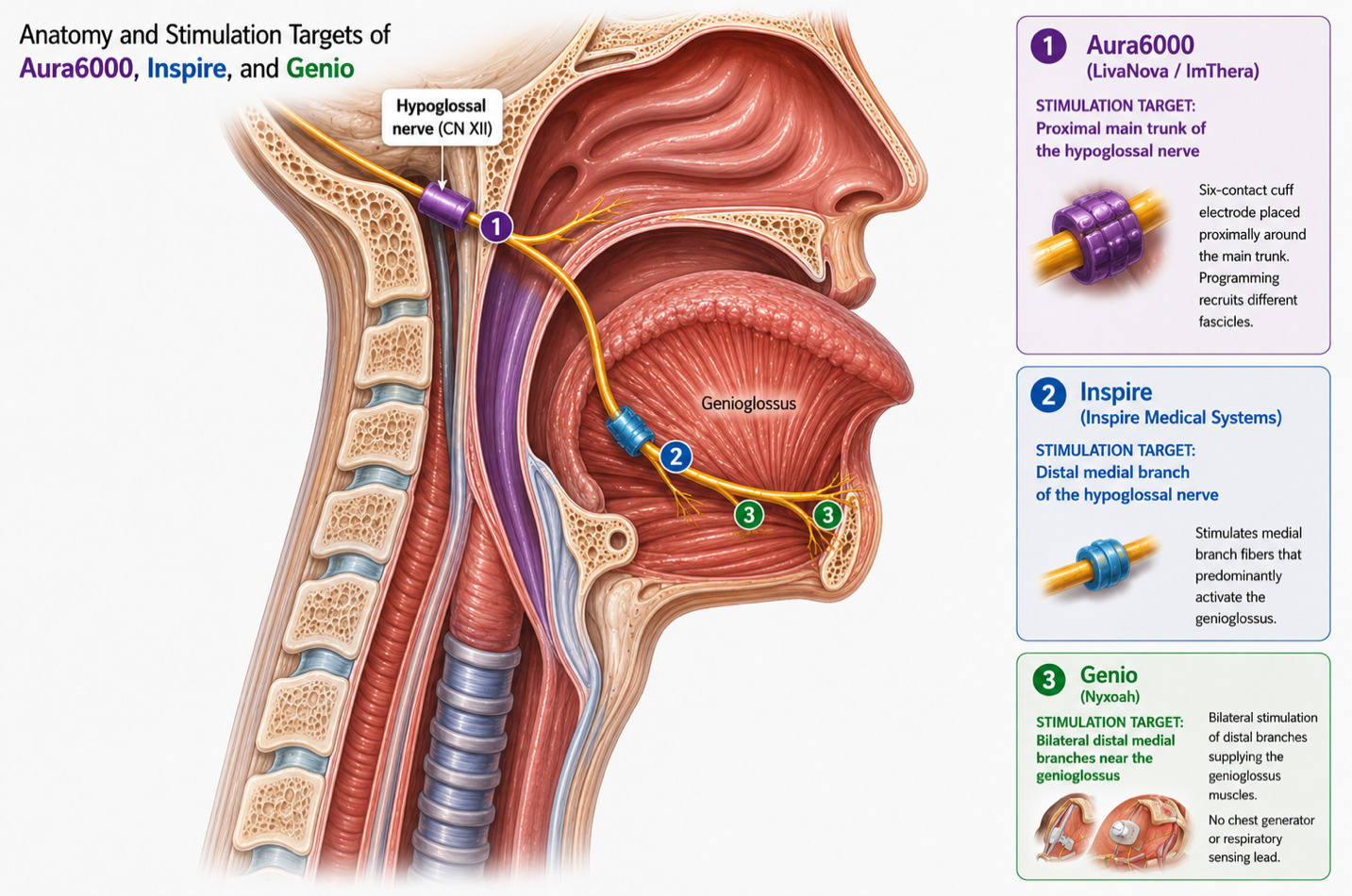
Hypoglossal nerve stimulation (HNS), which activates tongue protrusor muscles to prevent pharyngeal collapse during sleep, has been commercially available as a unilateral implantable device (Inspire™, Inspire Medical Systems, Golden Valley, MN) since FDA approval in 2014.30 Early generations of the device were comprised of 3 components: a subcutaneous stimulating electrode implanted on the medial branch of the hypoglossal nerve, an intercostal respiratory sensing lead, and an implanted subcutaneous pulse generator (IPG) on the anterior chest wall. The device functioned by identifying the onset of respiratory effort with the sensing electrode, transmitting the information to the IPG, and then stimulating the hypoglossal nerve via the IPG.30 The newest generation of the device has eliminated the need for the respiratory sensing lead by incorporating the sensing function within the IPG.
A 2024 updated systematic review and meta-analysis by Kim et al. synthesized data from 30 studies across all major HNS platforms, finding that the Inspire device produced mean short-term AHI reductions of 20.14 events/h and long-term (beyond 12 months) reductions of 15.91 events/h, with ESS reductions of 4.90 to 5.02 points and ODI reductions of 12.95 to 14.16 events/h across follow-up intervals demonstrating durable efficacy and high adherence rates.31 A complementary systematic review and meta-analysis by Braun et al. focusing on patient-reported outcomes confirmed robust improvements in ESS, Functional Outcomes of Sleep Questionnaire (FOSQ), and snoring-related quality of life across HNS platforms, with benefit magnitude broadly consistent across short- and long-term follow-up.32 Regarding safety, a 2024 systematic review of adverse events in HNS by Wollny et al. found that serious device- and procedure-related events were uncommon, with tongue weakness (approximately 20%, typically self-resolving), wound complications, and device migration being the most frequently reported events across clinical trial and real-world datasets.33 A randomized, sham-controlled crossover trial by Dedhia et al. examining the cardiovascular effects of Inspire HNS in 60 patients with moderate-to-severe OSA found that mean 24-hour systolic blood pressure and other vascular endpoints were not significantly different between sham and active stimulation conditions, suggesting that HNS-mediated AHI improvement may not translate to short-term blood pressure reduction; a finding that parallels some earlier CPAP cardiovascular outcome trials and highlights the complexity of the OSA-cardiovascular relationship.34
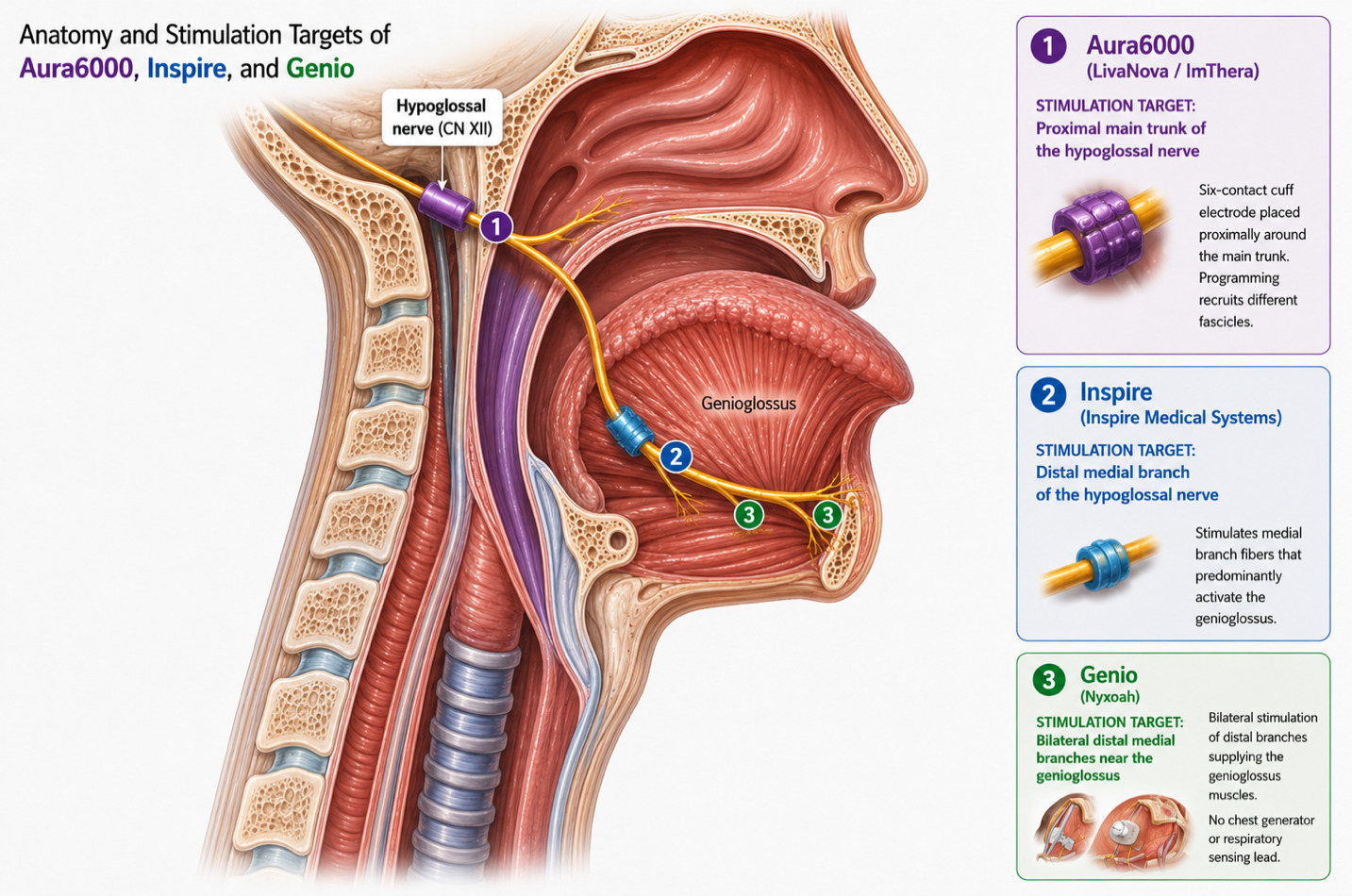
Recently, two other approaches to stimulating the hypoglossal nerve have received approval for clinical use. The Genio™ bilateral hypoglossal nerve stimulation system (Nyxoah SA, Belgium) represents a fundamentally different HNS approach. It consists of a single leadless implanted stimulation device without an internal battery or respiratory sensor that straddles the genioglossus. Using radiofrequency energy, stimulation of both distal branches of the hypoglossal nerves is achieved externally by a rechargeable controller worn on the submentum during sleep via an adhesive patch. This design eliminates the need for repeat surgeries for battery replacement and stimulation and respiratory sensing lead placement.
Using the Genio system, Woodson et al. reported the results of the Dual-sided hypoglossal nerve stimulation for the treatment of OSA (DREAM) trial, a prospective, multicenter, nonrandomized, single-arm pivotal trial conducted at academic and community centers across the United States, Europe, and Australia.35 The study enrolled 115 adults with moderate-to-severe OSA (AHI 15 to 65 events/h) who had failed, refused, or were intolerant of PAP therapy. Key inclusion criteria included BMI ≤32 kg/m2, absence of complete concentric palatal collapse on drug-induced sleep endoscopy, and at least 55 minutes of supine sleep on baseline polysomnography. The coprimary endpoints at 12 months were a minimum 50% reduction in AHI from baseline with a final AHI below 20 events/h, and a minimum 25% reduction in the 4% oxygen desaturation index (ODI).34
Study results found that the coprimary endpoints were met. The AHI responder rate was 63.5% in the full implanted cohort (N=115, P=0.002) and 81.8% in the per-protocol completers (N=88). The ODI responder rate was 71.3% (N=115, P<0.001) and 92.0% per protocol. Secondary analyses among the 89 participants at 12 months revealed a mean AHI reduction of 18.3 events/h and ODI reduction of 17.7 events/h (both P<0.001). Time with oxygen saturation below 90% was also significantly reduced. All patient-reported secondary endpoints improved significantly (P<0.001): ESS decreased from 9.7 to 6.2, FOSQ-10 increased from 16.0 to 18.2, and Symptoms of Nocturnal Obstruction and Related Events (SNORE-25) score fell from 1.6 to 0.6. Bed-partner-reported loud and very loud snoring declined from 83.5% at baseline to 30.4% at 12 months. Notably, both supine AHI and REM AHI were significantly reduced, suggesting efficacy in sleep positions and stages where existing unilateral HNS has shown limited effect.35
Device adherence was high: 84.3% of participants used the device more than 70% of nights with greater than 4 hours of nightly use in the 3 months preceding the 12-month assessment. Overall treatment satisfaction was 89.8%. Serious adverse events occurred in 10 (8.7%) participants; most device- and procedure-related adverse events were self-limited and resolved within the first postoperative month. Device migration requiring revision or explantation occurred in a small number of participants. The device was successfully implanted in 113 of 115 enrolled participants.35
Limitations of the DREAM trial include its single-arm design without a direct comparison to unilateral HNS or PAP, a predominantly white male cohort, and 23.5% participant attrition through 12 months, partly attributable to COVID-19 pandemic disruptions. Longer-term follow-up studies will be important to characterize durability and to compare efficacy and safety profiles with the established INSPIRE device and well as aura6000 System (vide infra).
The other hypoglossal nerve stimulation device that has recently achieved FDA approval is the aura6000 system (LivaNova PLC, London, UK). This device provides unilateral stimulation to the proximal hypoglossal nerve. While the Inspire distal hypoglossal nerve stimulation system places a three-electrode cuff on the medial branch of the hypoglossal nerve and requires DISE screening to exclude complete concentric velopharyngeal collapse (CCC) and a BMI below 32 kg/m2, the aura6000 places a six-electrode cuff on the proximal trunk of the hypoglossal nerve, providing broader access to the full complement of tongue musculature and enabling customized stimulation titration across multiple electrode configurations.35 Critically, neither a respiratory sensing lead nor DISE screening is required for eligibility, eliminating the two most restrictive barriers to existing unilateral HNS candidacy and potentially enabling patients with CCC—historically excluded from Inspire treatment—to receive therapy.36
There have been two studies supporting the efficacy of the aura6000 system. The THN3 trial was a multicenter randomized controlled trial of the aura6000 platform conducted at 20 centers and enrolling 138 patients with moderate-to-severe OSA (AHI 20–65 events/h; BMI ≤35 kg/m2). Results demonstrated that 11 months of proximal hypoglossal nerve stimulation produced a significant −14.4 events/h treatment difference in AHI compared with the control period, with corresponding improvements in ODI, ESS, FOSQ, and quality of life. Crucially, THN3 did not require DISE screening and enrolled patients with higher BMI than the pivotal trial of Inspire (STAR) thus demonstrating meaningful efficacy in a broader population. However, one of four prespecified primary endpoints (the long-term AHI responder rate) was not met.37
The second trial of the aura6000 system was the OSPREY (Obstructive Sleep apnea Proximal Rearrangement study) trial. It was a prospective, multicenter, randomized controlled open-label trial comparing the aura6000 system against a no-stimulation control in adults with moderate-to-severe OSA who had failed or were unwilling to use PAP therapy. OSPREY enrolled patients with greater OSA severity and higher BMI than the STAR trial which had demonstrated the efficacy of Inspire approval. It was explicitly designed to include patients at risk for CCC.36 At 13-month follow-up (representing 12 months of active stimulation therapy), the treatment arm responder rate was 65%, defined as achieving at least a 50% improvement from baseline AHI combined with a final AHI below 20 events/h. Median AHI declined from 34.3 to 11.0 events/h, representing a 68% reduction. Median ODI declined in parallel from 34.9 to 11.1 events/h, also a 68% reduction. The onset of response was notably rapid: approximately one in four participants met the responder definition on day one of therapy, 50% by month three, and the full 65% responder rate was achieved by the 12-month mark. Clinically meaningful improvements in the ESS and FOSQ were observed at 12 months as secondary endpoints. No serious adverse device-related or procedure-related events were reported throughout the study period.36
With FDA approval of the Genio and aura6000 system, there are now 3 systems for hypoglossal nerve stimulation with important differences in their approach to stimulation as shown in the Figure. Inspire provides unilateral stimulation to a distal branch of the hypoglossal nerve. Genio Bilateral delivers non-specific broad bilateral stimulation of the proximal hypoglossal nerve. The aura6000 system enables targeted unilateral stimulation of the distal hypoglossal nerve. Without comparative efficacy studies, it is unclear whether one system is better than the other. Furthermore, whether there are specific OSA endotypes that would benefit from one system versus the other also remains to be determined.
Broader Landscape and Emerging Themes
The therapies reviewed here reflect an evolving appreciation that OSA is a heterogeneous disorder with distinct pathophysiological endotypes—including excess weight and upper airway collapsibility, elevated loop gain, low arousal threshold, and reduced pharyngeal muscle responsiveness—each of which may benefit from targeted intervention.10 A critical review by Luu et al. of 41 randomized placebo-controlled pharmacotherapy trials spanning two decades found that most endotype-targeted agents have been studied in early-phase, underpowered trials with short durations and inconsistent findings.10 Importantly, even in trials designed around specific endotypes, reductions in AHI did not consistently correlate with changes in the targeted physiological trait, raising questions about whether current endotype classification frameworks are sufficiently refined for precision therapy selection.10
Tirzepatide currently stands as the benchmark for pharmacotherapy in OSA, being the only agent shown in Phase 3 trials to simultaneously reduce AHI, improve patient-reported sleep outcomes, and attenuate cardiometabolic risk factors including systolic blood pressure and systemic inflammation.2 Its approval represents a paradigm shift: for the large subset of patients with OSA attributable to obesity, pharmacotherapy targeting the underlying causal mechanism now constitutes an evidence-based option. However, the trial population’s high BMI, exclusion of diabetic patients, and 52-week follow-up limit generalizability to the broader OSA population and leave long-term cardiovascular outcomes unaddressed.2,10 Data also indicate that cessation of treatment results in regain of weight raising the specter of indefinite or lifelong therapy.38 Furthermore, availability is limited because of the high cost of the medication and restricted access by insurance plans.
AD109 offers a distinct and potentially complementary option for patients without significant obesity. Unlike prior noradrenergic/antimuscarinic combinations using racemic oxybutynin, the pairing of atomoxetine with aroxybutynin at the 2.5/75 mg dose appears to achieve upper airway muscle augmentation while preserving sleep architecture which is an important clinical advantage.17 The breadth of the Phase 3 enrollment across OSA severity categories and the inclusion of nearly equal proportions of women and men distinguish this program from earlier pharmacotherapy trials.19 Beyond these two agents, carbonic anhydrase inhibition is the most advanced of the remaining pharmacological strategies, although Phase 3 evaluation of sulthiame will be required before its role can be established, and agents directed at residual sleepiness address a complementary problem rather than the respiratory disturbance itself.24
For patients who prefer or require non-pharmacological, non-PAP approaches, the Transoral awake neuromuscular electrical stimulation device, bilateral HNS, and proximal unilateral HNS expand the therapeutic menu across the full spectrum of OSA severity. Transoral awake neuromuscular electrical stimulation device is positioned as a non-invasive daytime option for mild OSA and primary snoring, where PAP adherence is notoriously difficult to achieve. Bilateral hypoglossal nerve stimulation (Genio) and proximal unilateral hypoglossal nerve stimulation (aura6000) both address moderate-to-severe disease refractory to PAP therapy, with the former offering an externally powered leadless implant and the latter providing a broader-eligibility alternative to the Inspire system that no longer requires DISE screening or excludes patients with complete concentric collapse.26 KPAP, if confirmed in adherence-focused trials, may reduce the primary barrier to PAP use—pressure discomfort—without sacrificing therapeutic efficacy.3
Taken together, these developments underscore an emerging paradigm in which OSA treatment is increasingly matched to the individual patient’s pathophysiology, comorbidity profile, and preferences. Ongoing and future research priorities include long-term cardiovascular outcomes trials for the newer pharmacological and device-based modalities, comparative effectiveness studies between therapeutic modalities including head-to-head HNS device comparisons, prospective endotype-selected pharmacotherapy trials, integration of hypoxic burden and other polysomnographic biomarkers into clinical decision pathways, and assessment of combination strategies for patients with complex OSA phenotypes.10,34
Conclusion
The OSA treatment landscape is undergoing its most significant transformation in decades. KPAP offers a potentially more tolerable PAP delivery mode with equivalent efficacy. Tirzepatide has established pharmacotherapy as a clinically viable option in obese patients with OSA and received FDA approval as the first drug for this indication. AD109 is advancing toward FDA submission with compelling Phase 3 evidence for patients regardless of obesity status. The Transoral awake neuromuscular electrical stimulation device provides a well-tolerated daytime option for mild disease. The Genio device offers bilateral proximal hypoglossal nerve stimulation using an externally powered neuromodulation approach for PAP-intolerant patients with moderate-to-severe disease. Proximal unilateral HNS with the aura6000 system extends hypoglossal nerve stimulation to a broader patient population by eliminating DISE screening requirements and accommodating patients with complete concentric collapse—thereby expanding access to neuromodulation therapy for the large proportion of CPAP-intolerant individuals previously deemed ineligible. Carbonic anhydrase inhibition and pharmacotherapy for residual sleepiness remain under investigation and are not yet established components of routine care. Progress in endotyping and phenotyping is beginning to provide a scientific rationale for matching specific therapies to specific pathophysiological profiles, moving OSA care toward a precision medicine model. Each modality now available addresses a distinct aspect of OSA pathophysiology, and the growing evidence base supports an individualized, mechanism-based approach to treatment selection in which patient preference, comorbidity, disease severity, and pathophysiological endotype together guide therapeutic choice.