
Introduction
Interstitial lung disease (ILD) encompasses a group of diffuse parenchymal lung diseases with varied clinical, radiographic, and pathologic manifestations. Idiopathic pulmonary fibrosis (IPF) is a progressive fibrotic disease with a poor prognosis. Additionally, a subset of non-IPF ILD may also adopt a similarly progressive fibrotic phenotype.1 Assessing exertional limitation is therefore important for prognostication and identifying early decline. Resting studies, such as pulmonary function testing, may not be sensitive enough to detect the physiological impairments previously described.2 Several studies have linked lower peak oxygen uptake (V̇O₂), walking distance, and gas-exchange abnormalities on exercise testing to poor survival.3–5
Pulmonary rehabilitation (PR) is defined as “an evidence-based, multidisciplinary, and comprehensive intervention for patients with chronic respiratory diseases who are symptomatic and often have decreased daily life activities,” and it is well known to benefit patients with chronic obstructive pulmonary disease COPD.6 There is evidence supporting its use in those with ILD as well, though current clinical guideline recommendations are based on moderate-quality evidence and conflicting results.7 This discrepancy is likely due to the heterogeneous cohorts studied and variation in the pulmonary rehabilitation program protocols.
Despite these benefits, utilization of PR in chronic lung disease remains low due to a multitude of patient-, geographic-, and health system-related factors.8–11 It is estimated that less than 3% of patients with chronic lung disease access PR per year globally, with most data collected in COPD and IPF cohorts.12 Telerehabilitation, which uses videoconferencing to enable patients to perform home-based PR, is therefore gaining interest as an alternative for patients with chronic respiratory disease, as it may overcome barriers that limit patient access to center-based PR. Given the relatively recent introduction of this modality for delivering exercise training, its feasibility, validity, and safety compared with center-based PR in patients with ILD require further analysis and will be explored in this narrative review.
Physiology of Exercise in ILD
Exertional desaturation and exercise limitation are key consequences of pulmonary, neuromuscular, and circulatory derangements in IPF and PPF-ILD.6 At a physiologic level, ventilation-perfusion (V/Q) mismatch predominates, followed by diffusion impairment and abnormalities of pulmonary vasculature, collectively leading to functional impairment and reduced health-related quality of life (HRQoL).13 In a study by Agusti et al13 In patients with IPF, decreased arterial partial pressure of oxygen and higher mean pulmonary artery pressure per unit flow were observed during exercise compared with rest, with lower mixed venous oxygen saturation and an increased alveolar-to-arterial oxygen gradient. Providing oxygen supplementation during exertional desaturation improves overall exercise performance and heart rate response in various ILD diagnoses.14 Despite this improvement, the use of supplemental oxygen in some studies may inconsistently benefit end-exercise dyspnea or the rapid, shallow breathing pattern associated with ILD.15,16 Skeletal muscle dysfunction, a known factor in exertional limitation in COPD literature, has also been described as an important contributor to exercise limitation in ILD. Nishiyama et al17 assessed forty-one patients with mild to moderate IPF and found a reduction of quadriceps muscle strength, which correlated with pulmonary function parameters and exercise capacity. These findings support the complex interplay of cardiac, pulmonary, and neuromuscular causes of exercise limitation in ILD. While exertional desaturation correlates with the severity of fibrotic injury, it should be noted that the gas-exchange pattern also depends on the cause of ILD and on therapeutic side effects, such as corticosteroid use and its association with myopathy.13,18
Exercise Limitation and Mortality in ILD
Exercise limitation in ILD has important prognostic implications and is associated with higher mortality, as demonstrated by objective reductions in maximal and submaximal exercise parameters. The six-minute walk distance (6MWD) is often used to measure submaximal exercise due to its safety, reliability, repeatability, and validity. In ILD, many studies report an increase in mortality in patients with reduced 6MWD, though thresholds differ between studies.5,19–23 Lederer et al20 retrospectively analyzed 454 patients with IPF who were listed for lung transplantation and reported that those with a 6MWD less than 207 meters had a fourfold higher mortality rate compared to others (adjusted rate ratio, 4.7; 95% confidence interval, 2.5–8.9; p < 0.0001); importantly, this was independent of anthropometrics, demographics, and comorbid conditions such as pulmonary hypertension and diabetes. Longitudinal change of the 6MWD has also shown independent prognostic value in patients with IPF, with du Bois et al23 reporting a 50-meter decrease in 6MWD at 24 weeks associated with a three-fold higher risk of mortality in the following year in a cohort of IPF patients from the INSPIRE trial.24 In addition, desaturation during the 6MWT is another important prognostic factor, reflecting impaired gas exchange during exercise in these patients.25 Lama et al26 showed in 103 patients with UIP and NSIP that desaturation (SpO2 <88%) during the 6MWT had up to four-fold higher mortality, even when adjusting for age, sex, smoking history, histologic diagnosis, percent predicted Forced Vital Capacity (ppFVC), and baseline predicted single breath diffusion capacity for carbon monoxide (DLCO)(p=0.00018).
Cardiopulmonary exercise testing (CPET), while more expensive to administer and less practical than the 6MWT, offers a comprehensive assessment of the respiratory, cardiovascular, and musculoskeletal systems in maximal exercise. Its role in prognostication may be less clear than the 6MWD, though several parameters measured in CPET could be useful in determining mortality risk. Layton et al27 performed CPET in 192 patients with ILD awaiting lung transplant, most of whom had severe IPF. All parameters in this cohort (peak workload, peak oxygen consumption (V̇O2), nadir oxygen saturation (SpO2), ventilatory equivalent for carbon dioxide (VE/VCO2), oxygen (O2) pulse, and end-tidal carbon dioxide (ETCO2)) were significantly different between those who died or received a lung transplant. Using multiple regression analysis, all measured parameters conferred a significant one-year mortality risk, with the independent predictors of death associated with reductions in peak work rate, followed by nadir SpO2 and ppFVC.
Furthermore, Vanshelboim et al22 assessed 34 subjects with IPF prospectively with a baseline CPET. The study found that peak work rate less than 62 watts (p = .005), peak V̇O2 ≤13.8 mL/kg/min (p = .031), minute ventilation to carbon dioxide ratio at the anaerobic threshold >34 (p = .02) were associated with poorer survival. Sixteen subjects then underwent a 12-week exercise training program, but there was no difference in survival between groups. In a meta-analysis by Barratt et al,28 prognostic associations of CPET were sought in several ILD subtypes (IPF n=762, Sarcoidosis n=144, and systemic sclerosis-associated ILD n=144). Conflicting results emerged about the prognostic value of peakV̇O2, VE/VCO2 at anaerobic threshold, and exercise-induced hypoxemia and one-year mortality in ILD. This was likely due to cohort heterogeneity, confounding variables, and inadequate statistical power, which limited the strength of the conclusions. In a heterogeneous disease such as ILD, accurate identification of exercise limitation may be an important marker of disease progression and death and requires further study.
Pulmonary Rehabilitation in ILD: Benefits and Barriers
Pulmonary Rehabilitation is a comprehensive behavioral intervention designed to improve overall exercise capacity and quality of life in patients with chronic lung disease.6,10,29 The essential components of PR include patient assessment, individually prescribed and progressively supervised exercise training, and a team of health care professionals to ensure quality assurance practices.7,11,29 Exercise training itself includes aerobic and resistance training at a minimum. Desirable components of PR may include structured education, psychological support, airway clearance techniques, upper limb training, and nutritional counseling. Many programs across the globe differ in the delivery and format of these desirable components, as these are affected by the availability of multidisciplinary resources.
The American Thoracic Society (ATS) recommends that adults with ILD participate in PR (strong recommendation with moderate-quality evidence).7,11 This recommendation is based on consistent evidence that PR improves exercise capacity, health-related quality of life, and dyspnea.30,31 In a meta-analysis of 21 studies by Dowman et al,31 for instance, the improvement in mean 6MWD was 40.07 meters (95% Confidence Interval (CI) 32.70-47.44), with improvement seen in peak V̇O2, peak workload, and maximum ventilation immediately after completion of PR. No adverse events were identified, supporting the excellent safety of PR. Notably, beneficial effects in 6MWD and subjective dyspnea scores lasted 6-12 months after the completion of PR, though this was not seen in the IPF subgroup. The survival benefit at long-term follow-up is still unclear. Many of these studies lacked standard training duration and frequency, and all programs included aerobic or combined aerobic and resistance training. Specific program characteristics that led to improvements in exercise capacity, measured by exercise testing or field walking tests, included a program duration longer than 8 weeks, supervision, and high-intensity interval training.32
While PR has initially been found to reduce hospitalization rates and mortality in COPD, it may also improve survival in ILD, based on emerging data.33,34 Data from two previous robust RCTs were analyzed and showed a positive but nonsignificant 5-year survival benefit among patients with ILD who participated in PR versus those who did not.34 After adjusting for baseline variables at 5 years, completion of PR was associated with a 44% lower risk of mortality (HR, 0.56; 95% CI, 0.36-0.8; p=0.01), and this survival benefit was more pronounced in milder disease and in non-IPF ILD.
The Barriers
Despite the benefits of center-based PR, referral, uptake, and completion rates are exceedingly poor both nationally and globally.8–11 Barriers to access are multifactorial and include patient-related, geographic, and health system-related barriers. For patients, PR may pose financial challenges, time commitments, and complexities that limit adherence. Other patient-related contributing factors also include comorbidities, burden of illness, fear of exercise, health literacy, and limited knowledge of PR benefits.9,12,35
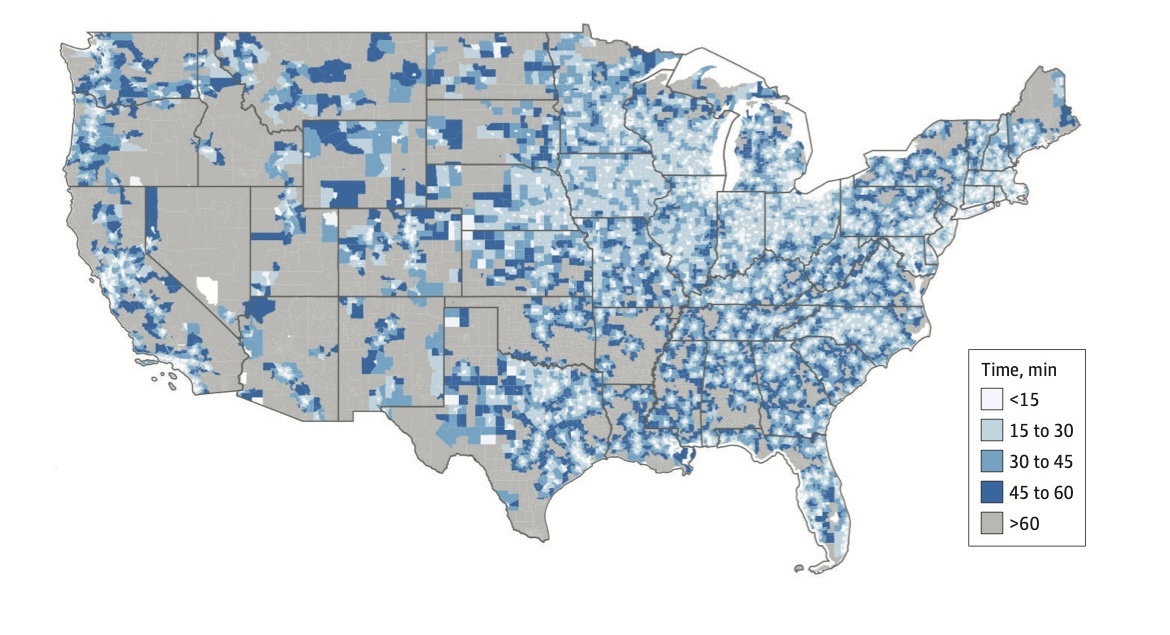
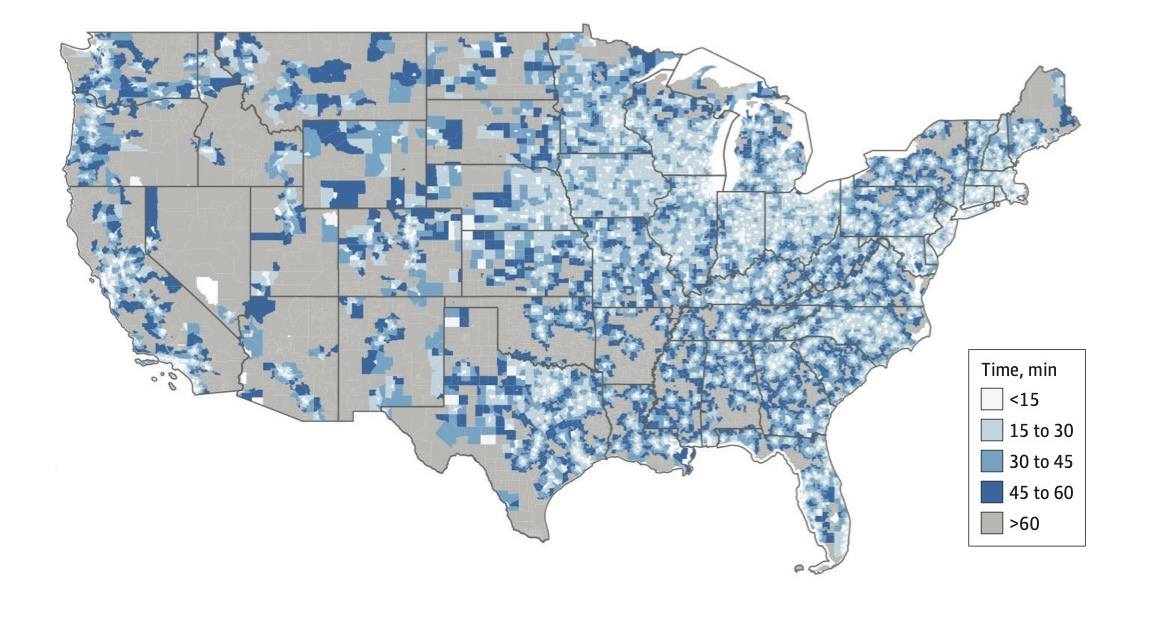
There are also significant geographic and racial disparities that affect access to PR programs. Kahn et al36 reported that 84.9% of US center-based PR programs are in urban areas (1494 of 1759 PR sites), with roughly half of the total US population within a fifteen-minute drive of a PR program (Figure 1). Notably, rural areas had limited PR programs, and travel times often exceeded 30 minutes. PR programs have significant startup and staffing costs, which make it difficult for health systems to support them. Several studies also report racial disparities affecting access to PR programs, with American Indian and Alaska Native groups experiencing the longest travel times (>60 min) compared to other racial and ethnic groups.36
Finally, societal and health-related limitations also have profound effects on access to PR. Healthcare providers’ perception or lack of knowledge about PR benefits and the referral process leads to suboptimal referrals, while limited training of multidisciplinary healthcare providers to administer PR programs leads to a workforce shortage.37 Insurance reimbursement for PR is significantly lower than for cardiac rehabilitation, leading to underfunding and under-resourcing of existing programs. Centers for Medicare & Medicaid Services payment rates show significant disparity between cardiac and pulmonary rehabilitation programs ($126.03 versus $58.24 in 2024).38 These barriers create logistical and financial hurdles for health systems.
Telerehabilitation in ILD: A promising alternative to center-based PR?
Telerehabilitation is an emerging resource that could increase accessibility by remotely delivering PR via various modes of telecommunication or virtual technology with or without remote monitoring.39 This could include telephone, internet, mobile application, or videoconferencing. Much of the data assessing telerehabilitation focuses on patients with COPD, who are affected by significant heterogeneity in exercise and protocols. Few studies assess maintenance PR and long-term follow-up. Nevertheless, a meta-analysis (n=1904) by Cox et al39 reported equivalent results compared to in-person PR in functional exercise capacity (6MWD), dyspnea, HRQoL measurements, and safety events. Adherence favored telerehabilitation over in-person PR (completion rates: 93% vs 70%).
In the ILD population, the use of telerehabilitation has been reported in only 7 interventional studies. Each has significant heterogeneity in exercise protocols and diagnoses, making it difficult to provide consistent recommendations for specific ILD subtypes (Table 1). The delivery modes included supervised videoconference-based PR, a virtual autonomous physiotherapist assistant (VAPA), smartphone applications, self-paced courses, and video game-based exercises.
Videoconference-based PR was studied by two groups. Aktan et al42 studied 28 patients with IPF using inspiratory muscle training delivered via weekly videoconference sessions with a physiotherapist, supplemented by home-based and self-monitoring. The 8-week course showed significant improvement in maximal inspiratory pressure, reduced dyspnea, and increased 6MWD. O’Shea et al45 conducted a feasibility study in 16 IPF patients using group-based videoconferencing sessions consisting of aerobic and resistance training and education. This study showed improvement in 6MWD and sit-to-stand (STS), although no changes were observed in physical activity levels or quality of life. Both studies showed better adherence compared to other modes.
Cerdan-de-las-Heras et al42 conducted a randomized trial of twenty-nine stable IPF patients using a 12-week telerehabilitation protocol versus a control group of usual care (without PR). Telerehabilitation was delivered using a virtual autonomous physiotherapist assistant (VAPA), a software that consolidates custom-built exercise programs, questionnaires, and chat functions with biometric sensors. The intervention lasted three months and included aerobic and resistance training without inspiratory muscle training (10-20 minutes per week, 3-5 times per week). The primary endpoint was change in 6MWD, with statistically significant changes observed at 3 months and 6 months post-intervention but not at 9 months. There were also no statistically significant changes in PFT parameters and HRQoL indices. Adherence was also better among participants who continued training after the intervention (64%, 108%, and 110% at 3, 6, and 9 months, respectively). No adverse events were reported.
The VAPA telerehabilitation protocol was also studied in thirty patients with sarcoidosis with various Scadding stages,43 with no statistically significant improvements in 6MWD, HRQoL indices, and PFT parameters in the intervention group. Adherence declined with time, and no safety events were reported. The authors concluded that the negative results could have been due to the relatively low exercise frequency, a less severe disease stage, and the lack of inspiratory muscle training in the exercise protocol. Other studies have found similarly mixed results in various outcomes when analyzing telerehabilitation in small studies of NSIP, LAM, and IPF.40,41,44,45 There are no studies, to our knowledge, assessing telerehabilitation and its effects on mortality and disease progression in ILD.
Child and colleagues40 evaluated a smartphone-based PR program in 15 patients with lymphangioleiomyomatosis (LAM). Over 12 weeks, patients performed aerobic and resistance training using an app with continuous physiologic monitoring via wearable devices. The study exhibited high adherence (87%) and improvements in 6MWD and quality of life, although no change was observed in FEV1 and FVC.
Self-directed online PR was assessed by Okker et al,43 which consisted of videos and written materials for patients with NSIP and IPF. This was a 6-month pilot feasibility study in which participants followed a structured exercise regimen that included daily aerobic activity and twice-weekly strength training. It showed improvements in 6MWD and STS; however, only 12 of 20 participants completed the program.
Finally, Yuen et al46 analyzed 20 patients with IPF in a randomized trial of an unsupervised telerehabilitation protocol that used a Wii Fit versus a control group (30 minutes a day, 3 times a week for 12 weeks). The results did not show a significant difference in 6MWD and HRQoL scores between baseline and post-intervention results. Adherence rate was only 20%, and no adverse events were reported. Although relatively few resources were used, the control and intervention groups differed in disease severity, and the lack of behavioral intervention may have affected the results. There was also a limitation in the intervention group: participants were not required to use whole-body movements to play the games, making it less physically taxing.
Safety and Limitations
The successful implementation of a telerehabilitation program relies on several key features. The unique delivery of this healthcare model requires a robust digital infrastructure, including reliable internet access, equipment, and sufficient resources for software operation and troubleshooting. Inexperienced users may also find operating a digital device and a telemedicine platform challenging and overwhelming, especially if training is required. Disability, such as visual, motor, or hearing impairments, and language barriers, can also exclude some patients if the technology and equipment are not inclusive. The digital nature of telemedicine also poses cybersecurity risks in the event of a patient data breach. Lastly, the lack of in-person supervision and peer support may also be a deterrent.47 These limitations pose unique access issues that could be just as problematic as center-based PR, despite its promise. Still, several real-world studies and survey data show that telemedicine can be adaptable and personalized to meet patient needs.48
Without the supervision provided by center-based PR, safety and monitoring are of utmost importance when designing a telerehabilitation program for ILD patients, who are prone to exertional oxygen desaturation. Child et al44 utilized a wrist-worn accelerometer and Bluetooth-connected pulse oximeter, which transmitted live data securely to a smartphone app. Safety measures in this study included advising participants to maintain a target SpO2 > 85%; participants with sustained low SpO2 below this threshold prompted the study physiotherapist to call the patient and reassess, leading to a revision of the exercise plan, discussion with a physician, or an increase in supplemental oxygen during exercise. An oxygen saturation threshold of >85% was set by the study investigators; however, there are no established consensus guidelines regarding optimal oxygen saturation during exercise in ILD. Other studies have used wearable devices for biometric monitoring or incorporated videoconferencing in group settings. Except for mild desaturation, no other studies reported adverse events.49 Further research is needed to standardize an ideal safety protocol and identify patients who can exercise safely without in-person supervision.
Conclusion and Future Directions
In conclusion, ILD is complicated by significant exertional desaturation and exercise limitation, which can impact survival and HRQoL. Reduction in submaximal and maximal exercise capacity is a poor prognostic factor. PR is a beneficial behavioral treatment for this heterogeneous disease, although patient-related, geographic, and societal factors can pose accessibility challenges. Telerehabilitation could address some of these problems and has shown promise as an alternative to center-based PR; however, implementation of this resource is hindered by a lack of standardized protocols and by digital infrastructure challenges for certain groups. Its validity, feasibility, and safety in the ILD population require further study . Future research should focus on long-term benefits, safety, delivery in both urban and rural areas, exercise protocols, and the proper identification of appropriate users of this technology.