
Introduction
Acute hypercapnic respiratory failure can be seen with multiple disease pathways, including both respiratory and neuromuscular diseases (NMD). It carries a high risk of death and readmissions. In-hospital mortality ranges between 7% and 13%.1,2 One-year post-discharge cumulative readmission and mortality risk is 62% and 26%, respectively.3 One in five patients are readmitted to the hospital within 30 days after discharge from a hospitalization due to acute hypercapnic respiratory failure.1 Conditions such as chronic obstructive pulmonary disease (COPD), obesity hypoventilation syndrome (OHS), cardiogenic pulmonary edema, bronchiectasis, asthma, and NMD can deteriorate into acute hypercapnic respiratory failure. Although many patients improve with medical therapy and NIV, some have persistent hypercapnia and require continuation of NIV post-hospital discharge.4–6
For patients in whom ambulatory NIV is indicated, there are known improvements in mortality, readmissions, quality of life, and dyspnea.4,7,8 Despite the clinical importance of NIV therapy, patient compliance remains a challenging factor.9 Optimizing post-discharge follow-up and care for patients discharged on NIV for persistent hypercapnia can reduce early readmissions and improve outcomes. We conducted a retrospective chart review of patients discharged from a large tertiary academic medical center on NIV therapy for persistent hypercapnia to assess the relationship between follow-up care and 30-day readmission rates.
Methods
Study Design and Population
We conducted a retrospective cohort study of adult patients (≥18 years) discharged from Banner— University Medical Center, a tertiary academic hospital affiliated with the University of Arizona, between December 1, 2023, and April 1, 2025, who were given a new prescription for NIV after an admission for acute or acute-on-chronic hypercapnic respiratory failure (CHRF). The institutional review board approved the study (IRB #00005656). CHRF was defined by clinical diagnosis and/or documented hypercapnia (PaCO₂ >45 mmHg on an arterial blood gas) in the setting of known NMD, OHS, COPD, or chest wall deformity. Patients were identified through hospital discharge records and durable medical equipment (DME) orders for bilevel noninvasive ventilation (BiNIV), average volume assured pressure support (AVAPS), or other home NIV modalities initiated at discharge.
Post-discharge follow-up was assessed based on visits to a primary care physician, pulmonary clinic, or sleep medicine clinic. Patients were included if they had a documented diagnosis of CHRF, new initiation of home NIV therapy at discharge, and available follow-up data within the institution. Clinical data were verified through manual chart review.
Patients were excluded if they had prior use of home NIV before admission, died during the index hospitalization, or were discharged to hospice.
Data Collection
Electronic health records (EHR) were manually reviewed to extract relevant data, including patient demographics, primary diagnoses, dates of hospital admission and discharge, documentation of post-hospitalization follow-up visits, and 30-day readmission events. The primary outcome was rehospitalization within 30 days of discharge from the index admission. The primary variable evaluated was outpatient follow-up after discharge. Data regarding any history of NIV therapy in the 12 months prior to hospitalization were collected from the medical record. There were no missing data among study participants.
Statistical Analysis
Descriptive statistics were used to summarize patient characteristics and clinical variables. Categorical variables were reported as counts and percentages. Comparative analyses were performed to evaluate differences in 30-day readmission rates between patients who completed follow-up and those who did not. A two-sided chi-square test was used to assess the association between follow-up completion and 30-day readmission rates. A p-value <0.05 was considered statistically significant. All statistical analyses were performed using Microsoft Excel.
Results
Between December 1, 2023, and April 1, 2025, a total of 71 patients were discharged with NIV, with 58% female and 42% male, indicating a modest female predominance (Table 1). The patient age range with 68% between ages 45–75, while 23% were under 45 and 17% were over 75, demonstrating that the majority of NIV initiation occurred in the middle to early late-aged adult population. OHS represented the most common underlying condition, accounting for 77% of the cohort, followed by COPD at 20%, reflecting that chronic hypercapnic respiratory failure in this cohort was predominantly obesity-related rather than driven by obstructive lung disease. The average BMI of patients diagnosed with OHS is 45 kg/m². NMD and other causes were uncommon, together comprising only 7% of patients. All patients were prescribed AVAPS on discharge.
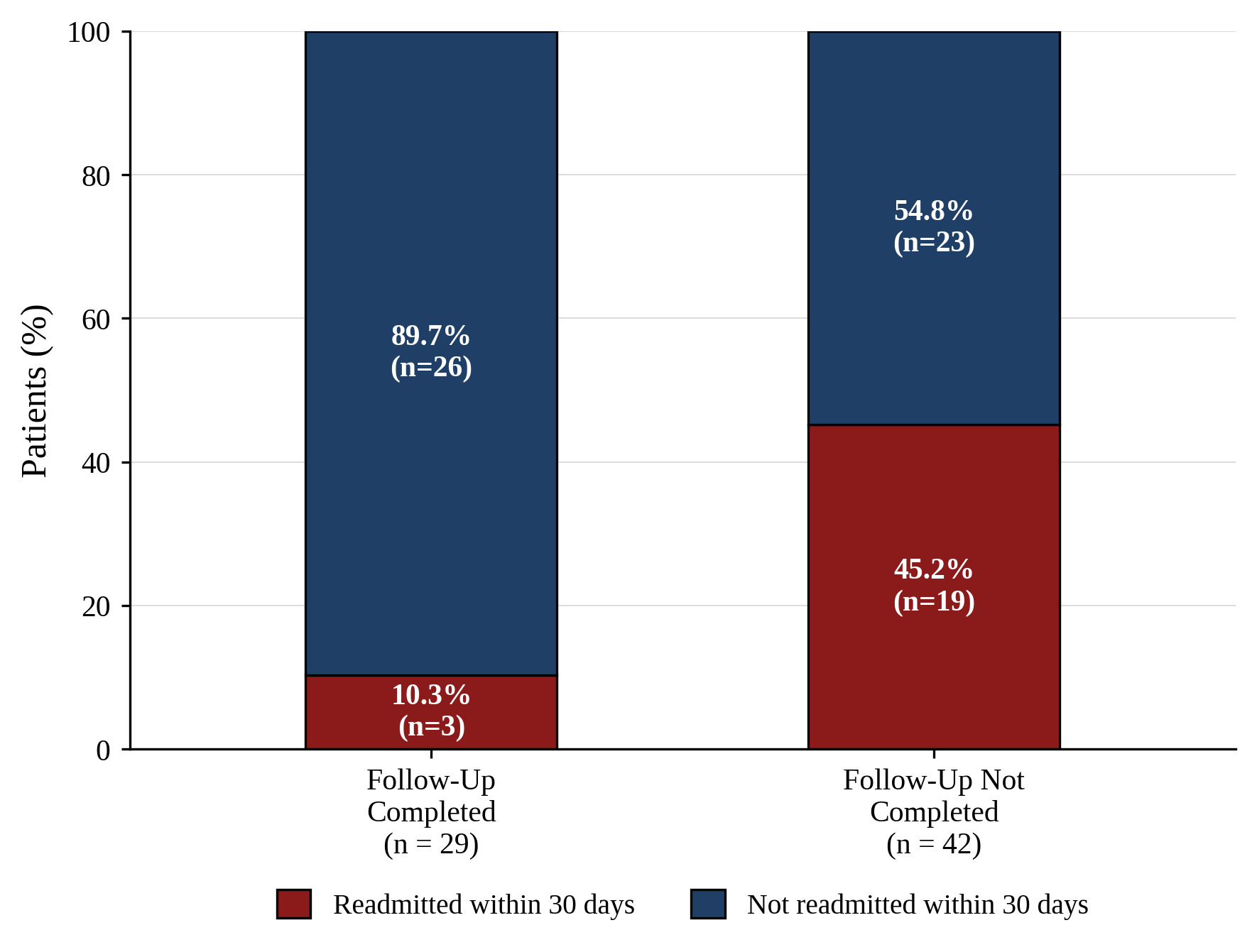
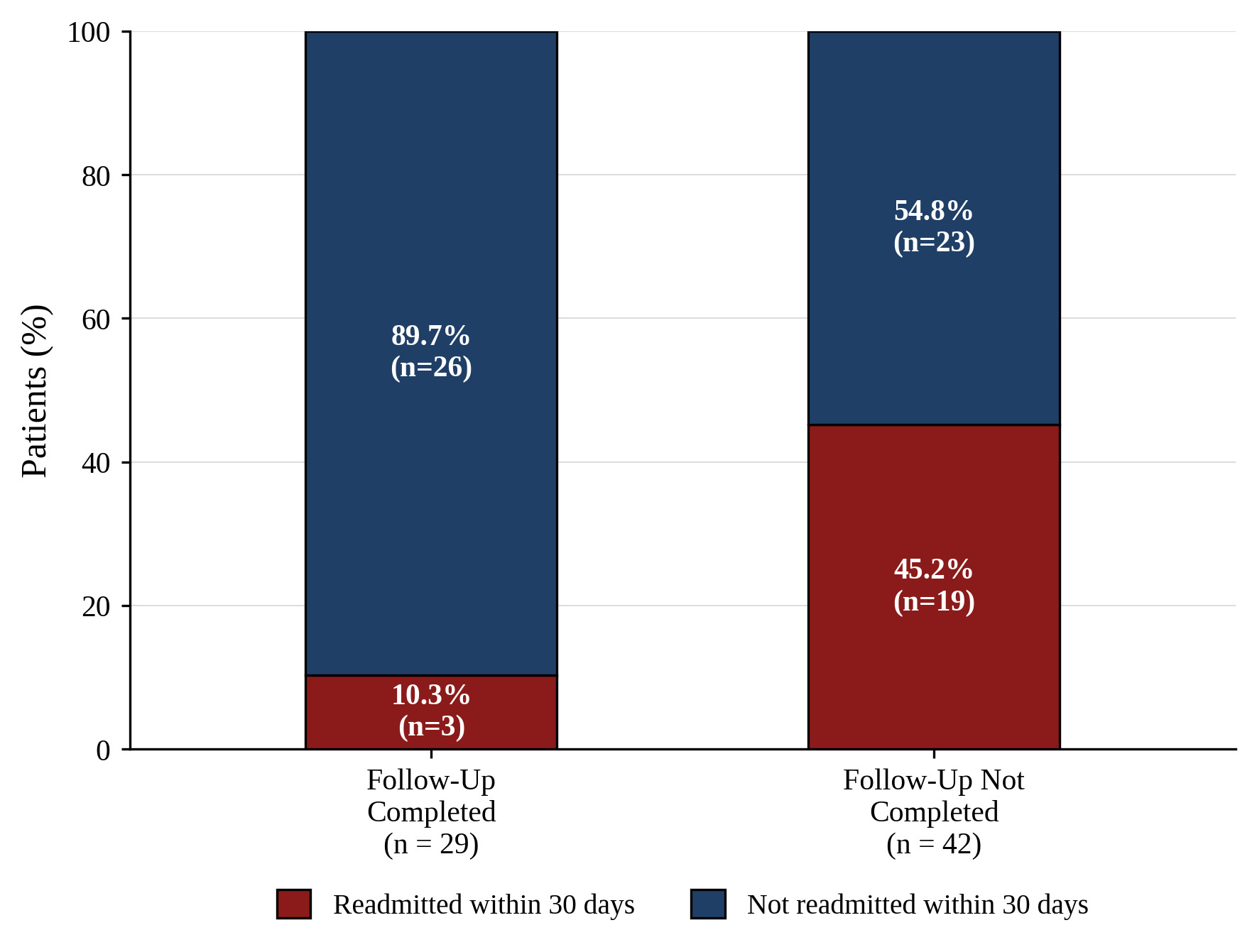
Of the 71 patients, 29 patients (40.8%) had a documented medical follow-up visit within 30 days of discharge, while 42 patients (59.2%) did not. Among patients who received timely follow-up, 3 out of 29 (10.3%) were readmitted within 30 days. In contrast, 19 out of 42 patients (45.2%) who did not complete medical follow-up were readmitted during the same period (Figure 1).
All 71 medical records were reviewed retrospectively for 1 year prior to the initial hospital admission date to assess if patients had had prior hospitalizations before being started on NIV. A total of 32 patients (45%) had been hospitalized in the year preceding NIV initiation, accounting for a total of 76 hospitalizations. The average number of hospitalizations per readmitted patient was 2.37.
Discussion
In this retrospective cohort study, 71 patients were newly initiated on NIV by hospital discharge. Upon discharge, fewer than half (40.8%) of the cohort completed outpatient follow-up within 30 days. Patients who received timely follow-up had significantly lower 30-day readmission rates than those without follow-up (10.3% vs. 45.2%, p=0.0018). Nearly half of the cohort had been hospitalized at least once in the preceding year, accounting for 76 total admission events. This pattern highlights a substantial burden of recurrent destabilizations prior to NIV initiation and suggests missed opportunities for earlier recognition of CHRF. Our findings contribute to the growing evidence that timely post-discharge evaluation may be an actionable and underutilized lever for reducing readmissions in this high-risk population.
Several prior studies support the association between structured post-discharge care and improved outcomes in patients with chronic respiratory failure. Early outpatient follow-up has been shown to reduce readmission risk in COPD, chronic hypercapnia, and other respiratory conditions, with NIV improving mortality, quality of life, and exacerbation frequency when appropriately implemented.1–4 Moreover, ambulatory management programs and structured NIV clinics have demonstrated improved adherence and fewer decompensations compared with standard care.5–7 The present study aligns with these observations and reinforces the role of timely post-hospital evaluation as a critical component of effective NIV therapy.
HCRF represents the final common pathway of decompensated obstructive, restrictive, neuromuscular, and obesity-related respiratory diseases. It is associated with high in-hospital mortality, frequent readmissions, and long-term morbidity.8–10 Persistent hypercapnia after acute hospitalization is a known predictor of recurrent exacerbations, and untreated or inadequately managed ventilatory failure can lead to worsening gas exchange, decreased functional capacity, and increased mortality. NIV is well established as an effective therapy for chronic hypercapnic respiratory failure, particularly in COPD and OHS, where it has been shown to improve survival, reduce exacerbations, and enhance quality of life.11–13 Ensuring appropriate outpatient evaluation after initiation of NIV is therefore essential for titration, troubleshooting, and addressing factors that influence adherence.
This study has several strengths, including manual chart verification of all clinical data and the evaluation of a clearly defined, high-risk population newly started on NIV at discharge. However, important limitations must be acknowledged. This was a single-center retrospective analysis with a modest sample size. Comorbidity data were not collected, limiting the ability to adjust for confounders that may influence readmission risk. The retrospective design precludes causal inference, and unmeasured factors such as disease severity, socioeconomic variables, or prior healthcare utilization may have contributed to observed differences. Notably, approximately half of patients without follow-up did not experience readmission, suggesting the presence of meaningful clinical heterogeneity within this subgroup. Future work aimed at identifying patient-level predictors of readmission could aid in developing targeted treatment plans.
Limitations
This study has several important limitations that warrant careful consideration when interpreting the findings. First, the observational and retrospective design introduces susceptibility to time-dependent exposure bias and reverse causality. Outpatient follow-up was defined as completion within 30 days of discharge, while the primary outcome was 30-day readmission. Patients readmitted early inherently had less opportunity to complete follow-up, which may have led to their preferential classification into the non–follow-up group and exaggerated the apparent protective association. As such, the analysis cannot establish causality, and the findings should be interpreted strictly as descriptive and hypothesis-generating.
Second, the analysis was unadjusted and therefore vulnerable to substantial confounding. Completion of outpatient follow-up likely reflects multiple unmeasured factors including disease severity, comorbidity burden, discharge disposition, social support, access to transportation, socioeconomic barriers, and system-level factors in the outpatient care system that independently influence readmission risk. Without comprehensive covariate capture or multivariable or time-to-event modeling, the observed association between follow-up and readmission cannot be interpreted as an independent effect.
Third, outcome and exposure ascertainment may be incomplete. Follow-up visits and readmissions were captured using a single health system’s EHR, raising the possibility that encounters occurring outside the institution were missed. This under-ascertainment could result in misclassification of both exposure and outcomes and may bias estimates in either direction.
Fourth, statistical power was limited by the modest sample size and low number of readmission events, particularly in the follow-up group. The small counts constrain the robustness of inferential testing and preclude precise estimation of effect size and uncertainty. Consequently, the findings should not be viewed as definitive estimates of risk reduction.
Fifth, several reporting and definitional limitations should be acknowledged. Operational definitions of “follow-up” (e.g., in-person versus telehealth, specialty versus primary care, completed versus scheduled) and “readmission” (e.g., all-cause versus related, planned versus unplanned, same-hospital versus any-hospital) were broad and may introduce heterogeneity. Additionally, detailed characterization of NIV settings and titration practices was limited by the retrospective nature of the data.
Finally, generalizability is constrained by cohort composition and treatment uniformity. The study population consisted predominantly of patients with OHS, and interestingly, all patients were discharged on AVAPS therapy. While clinically relevant, these features may limit applicability to broader populations with chronic HCRF or alternative NIV strategies.
Our study suggests that among patients newly initiated on NIV at hospital discharge, timely outpatient follow-up is associated with substantially lower 30-day readmission rates. These findings highlight the need for more structured and reliable post-discharge care pathways for patients with chronic hypercapnic respiratory failure.
Conclusion
Timely outpatient follow-up within 4 weeks of discharge was associated with significantly lower 30-day readmission rates among patients with chronic hypercapnic respiratory failure who were initiated on NIV. These results underscore the importance of structured transitions of care from hospital to home for this high-risk population. Continued investigation should focus on scalable strategies to ensure timely evaluation, optimize NIV adherence, and improve long-term outcomes in this vulnerable population. Given the substantial morbidity, mortality, and healthcare utilization in these patients, early post-discharge care, particularly prompt specialty follow-up, should be prioritized as a key quality improvement target.